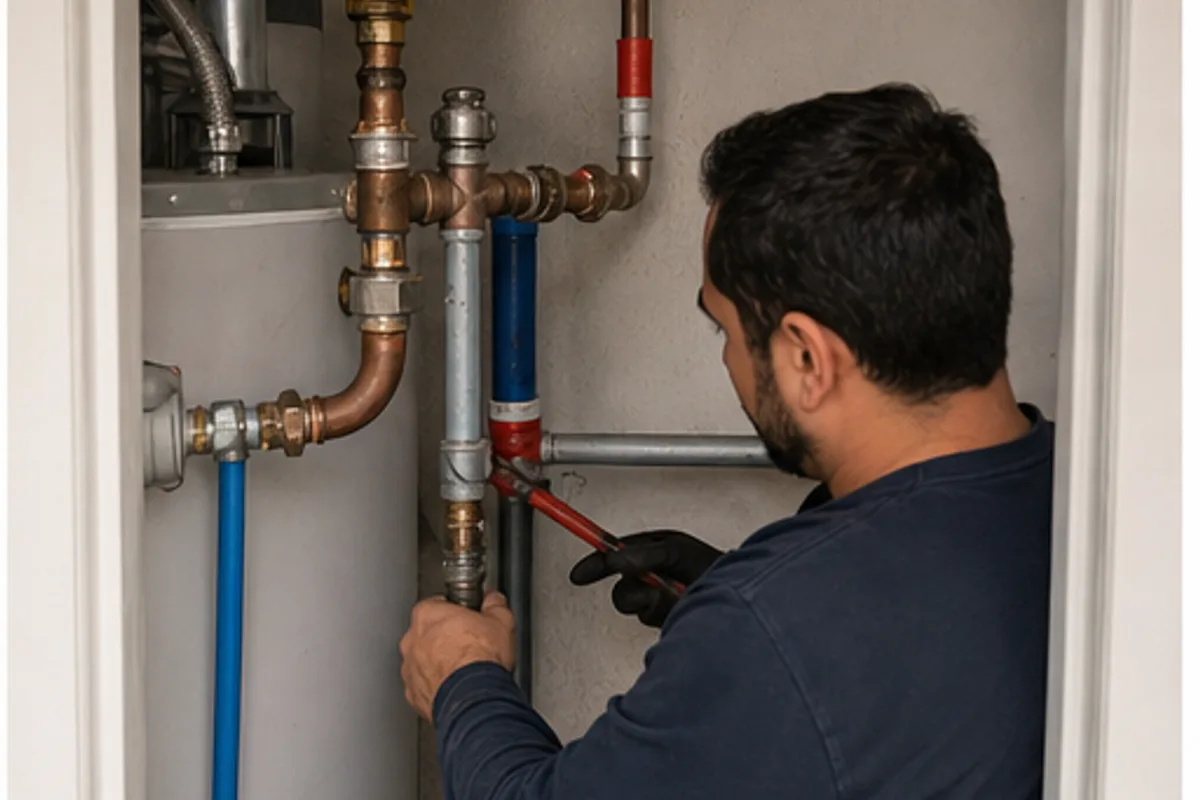
tankless water heater installation in West Covina.
Quick answer: Circuit & Cistern LA provides tankless water heater installation in West Covina with a retrofit-first check of the symptom, access, utility context, permit path, and related air, power, or water systems.
For this page, the service promise is practical: install tankless systems with gas sizing, venting, condensate, water quality, electrical outlet, recirculation, and permit coordination. The local reason is equally important: West Covina sits in the SGV basin, where larger postwar homes, remodels, and attached garages and side-yard HVAC, garage panels, and water-heater closets can change labor, timing, and inspection readiness.
If the problem is active, unsafe, wet, hot, sparking, backing up, not cooling, not heating, or producing gas-appliance concerns, book the visit and include photos immediately. If it is not urgent, use this page to decide what needs to be checked before a technician prices the work.
The two things that most often change the job are the local home profile and the service-specific risk. In West Covina, the local profile is larger postwar homes, remodels, and attached garages with side-yard HVAC, garage panels, and water-heater closets. For tankless water heater installation, the risk is that tankless upgrades can be derailed by undersized gas lines, vent routing, hard water, condensate disposal, and clearance problems.
Field memo
How we would scope this tankless water heater installation visit in West Covina
For plumbing work, the visible leak or stoppage is only the start. The better quote asks where the water can be shut off, where the drain actually runs, what material is being touched, and whether repair evidence is strong enough before opening finishes or digging. In West Covina, that trade lens has to be merged with City building authority, SCE and SoCalGas with local water-provider context, and the local access pattern: side-yard HVAC, garage panels, and water-heater closets.
Do not let the visit become a fixture-only quote before shutoff condition, pipe material, drain route, and water-damage risk are checked. For tankless water heater installation, the first evidence should cover gas line capacity, vent route, water hardness. The planning range on this site is $4 200 to $12 500, but that number is only useful after access, existing system age, permit path, and related-trade dependencies are documented.
For tankless water heater installation in West Covina, the planning issue is capacity and routing. Gas line sizing, vent path, condensate disposal, electrical outlet, water quality, service clearance, recirculation expectations, and permit path should be checked before a compact unit is treated as a simple swap.
The practical goal is to decide whether the first visit is a repair visit, a replacement estimate, an emergency stabilization, or a retrofit-readiness check. That choice affects parts, ladders, drain equipment, panel tools, camera gear, documentation, and whether work should stay open for inspection.
Water-system data points
main shutoff, fixture shutoffs, and water-heater isolation
pipe material transitions and visible corrosion
cleanout location, drain history, and sewer route evidence
venting, seismic strapping, pan, and TPR discharge details
water pressure, hard-water clues, staining, and moisture pattern
West Covina access notes
clear the garage wall around panels, water heaters, shutoffs, and rear parking routes before the technician arrives
measure the side-yard route because condensers, line sets, drains, conduit, and water-heater removal all need working room
West Covina field knowledge
West Covina background that shapes the tankless water heater installation scope
Era and stock: West Covina incorporated in 1923 but stayed largely agricultural until a massive postwar buildout between 1955 and 1972 made it one of the fastest-growing cities in California. The South Hills and BKK landfill-area neighborhoods filled in the 1970s and 1980s, and the city's housing stock is overwhelmingly mid to late twentieth century.
Housing mix: Postwar ranches and split-levels of 1,400 to 2,200 square feet on 7,500 to 10,000 square foot lots dominate the flats, with larger 1980s two-stories in the South Hills. Typical retrofit candidate is a two-story split-level with a single-zone system that cannot keep the upstairs comfortable past 4 PM in summer.
Streets and landmarks: Garvey Avenue, Cameron Avenue, and Amar Road carry the major east-west traffic, while Azusa Avenue, Sunset Avenue, and Glendora Avenue run north-south. The Westfield West Covina mall, Galster Wilderness Park, and the South Hills Country Club bracket the residential map, and the 10 and 605 interchange defines the northwest corner.
What drives most retrofits here: South Hills hillside lots see severe afternoon solar gain on west elevations, and the prevalence of two-story homes with a single thermostat drives demand for zoning retrofits or full dual-system conversions. Water at 16 to 20 grains and a large stock of original 1960s and 1970s ducting in vented attics make duct sealing and zoning the most common combined upgrade.
Permit gotcha for West Covina: West Covina Building Division runs a busy counter and enforces a strict requirement that HVAC changeouts include a HERS test registration number on the permit application before issuance. Forgetting to attach the registration adds a full counter visit, and South Hills addresses additionally trigger fire-zone vegetation review.
Local signal stack
SGV basin
City building authority
SCE and SoCalGas with local water-provider context
larger postwar homes, remodels, and attached garages
side-yard HVAC, garage panels, and water-heater closets
electrification scopes need a panel and future-load review before equipment selection
compact utility closets and older gas piping make pre-checks important before selecting the tankless model
tankless upgrades can be derailed by undersized gas lines, vent routing, hard water, condensate disposal, and clearance problems
This stack is why the page is not a doorway page. A tankless water heater installation visit in West Covina has a different access, utility, permit, housing, and failure-mode profile than the same service in a coastal condo, Valley ranch home, or Westside estate canyon.
What can go wrong with tankless water heater installation
The most expensive mistake is approving a narrow repair before the surrounding constraint is understood. A component can be replaced while airflow stays bad, a fixture can be installed while the shutoff is failing, a charger can be mounted before the panel is ready, or a drain can be cleared while a broken lateral remains undocumented.
For tankless water heater installation in West Covina, our first-pass checklist is gas line capacity, vent route, water hardness, condensate drain, service valves. That list is short enough to use during booking and specific enough to prevent most blind quotes.
Permit, utility, and inspection context
The authority starting point for West Covina is City building authority. Utility context is SCE and SoCalGas with local water-provider context. Depending on scope, the work may need a permit, plan review, utility service planning, rebate paperwork, HERS or energy-code documentation, or a final inspection. LADBS notes that work is not approved until inspected and accepted, and that covered or concealed work may need to remain visible.
That matters for homeowners because a cheaper visit can become expensive if drywall, stucco, trench, conduit, venting, or piping is closed before the right inspection stage.
tankless water heater installation cost drivers in West Covina
Driver
Why it matters locally
Homeowner action
Access
side-yard HVAC, garage panels, and water-heater closets can increase setup time, ladder needs, parking coordination, or equipment route difficulty.
Send photos before booking and clear the path.
Existing system age
larger postwar homes, remodels, and attached garages often means mixed-era equipment, pipes, ducts, and wiring.
Send model labels and prior repair history.
Utility and permit path
SCE and SoCalGas with local water-provider context and City building authority influence sequence and documentation.
Ask whether the work is repair, replacement, or upgrade.
Service-specific risk
tankless upgrades can be derailed by undersized gas lines, vent routing, hard water, condensate disposal, and clearance problems.
Approve diagnosis before approving a large replacement.
Planning range for tankless water heater installation: $4 200 to $12 500. This is not a guaranteed price; it is a useful starting range before access, condition, permits, and related trade needs are confirmed.
Homeowner checklist before the visit
Take a wide photo of the equipment or fixture and a close photo of the model or rating label.
Take a photo of the electrical panel, open breaker directory, water shutoff, gas shutoff, cleanout, thermostat, or access hatch if relevant.
Write down whether the problem is new, repeated, seasonal, triggered by another appliance, or connected to a recent remodel.
Clear side-yard HVAC, garage panels, and water-heater closets enough for tools, ladders, drain machines, replacement parts, or safe shutoff work.
Do not reset breakers repeatedly, ignore gas odors, run flooded equipment, or keep using a leaking water heater.
When to call now
Call or book immediately if there is active leaking, sewage backup, burning odor, sparking, wet electrical equipment, no cooling during heat, no heat with a safety concern, repeated breaker trips, a gas smell, visible smoke, or water spreading into finished rooms. If natural gas is suspected, leave the area and follow utility emergency instructions from a safe location.
When to plan instead of panic
If the system works but is old, inefficient, noisy, undersized, or incompatible with a planned EV charger, heat pump, ADU, repipe, or remodel, use a retrofit check. Planned sequencing usually costs less than emergency replacement because panel, pipe, duct, venting, and permit issues can be solved before demolition or equipment ordering.
Inspection-summary reviews from San Gabriel Valley Basin + East/Northeast LA River Corridor homes
Each review is also emitted in the page JSON-LD with a 1:1 match between visible and structured-data text. Author names use first name and last initial only, and ratings reflect the actual review (some 4-star reviews are included where homeowners flagged a real complaint that was resolved).
★★★★★Olivia T.Mayflower Village
Recessed retrofit and Lutron Caseta on 18 zones. Sounds simple but the 1958 K&T behind the ceilings had to come out first, which became a partial rewire of the second floor. They handled the plaster patches in-house and matched the original sand-finish texture. Three weeks instead of one, but the right call.
★★★★★Lourdes R.Baldwin Park
Five dead outlets traced back to a single failed daisy chain at one upstream receptacle that had lost its neutral. Tech found it in 20 minutes with a tone tracer, replaced the failed device with a Hubbell DR15F2WBKZ, and tested every box on the circuit. No upselling, just fixed what was broken.
★★★★★Patricio Q.Walnut
Tesla Wall Connector Gen 3 on a 60A breaker, 48A continuous. Existing 1996 panel was tight on capacity so they did a load study with Sense over a week before recommending a 200A upgrade. Talia walked us through the numbers in plain English. SCE Charge Ready Home rebate paperwork was already in the inspector packet.
Questions homeowners ask before booking
Do I need a permit for tankless water heater installation in West Covina?
West Covina Building Division runs a busy counter and enforces a strict requirement that HVAC changeouts include a HERS test registration number on the permit application before issuance. Forgetting to attach the registration adds a full counter visit, and South Hills addresses additionally trigger fire-zone vegetation review. For tankless water heater installation specifically, equipment replacement, new circuits, repiping, panel work, water-heater replacement, and concealed work commonly need permit or inspection planning. City building authority is the starting point.
What kind of homes are typical in West Covina, and how does that change tankless water heater installation?
Postwar ranches and split-levels of 1,400 to 2,200 square feet on 7,500 to 10,000 square foot lots dominate the flats, with larger 1980s two-stories in the South Hills. Typical retrofit candidate is a two-story split-level with a single-zone system that cannot keep the upstairs comfortable past 4 PM in summer. South Hills hillside lots see severe afternoon solar gain on west elevations, and the prevalence of two-story homes with a single thermostat drives demand for zoning retrofits or full dual-system conversions. Water at 16 to 20 grains and a large stock of original 1960s and 1970s ducting in vented attics make duct sealing and zoning the most common combined upgrade.
What should I send before booking tankless water heater installation?
Send photos of the equipment, panel, shutoff, access path, symptom, model labels, and any previous repair notes. For West Covina, include parking, alley, crawlspace, attic, garage, or HOA constraints because side-yard HVAC, garage panels, and water-heater closets can change the dispatch plan.
What local landmarks help dispatch find access in West Covina?
Garvey Avenue, Cameron Avenue, and Amar Road carry the major east-west traffic, while Azusa Avenue, Sunset Avenue, and Glendora Avenue run north-south. The Westfield West Covina mall, Galster Wilderness Park, and the South Hills Country Club bracket the residential map, and the 10 and 605 interchange defines the northwest corner. Note any cross-streets, gated communities, alley cleanouts, or hillside constraints in the booking note so the technician arrives ready for the actual route, not a curb-only assumption.
Can the same visit check related HVAC, electrical, or plumbing issues?
Yes. The site is built around air, power, and water coordination. A plumbing visit can also note visible panel, pipe, drain, shutoff, duct, water-heater, or condensate issues that should be considered before a larger upgrade.
Map the tankless water heater installation issue in West Covina before the scope expands.
Send the symptom, equipment photos, panel photo, shutoff location, access constraints, and urgency. The booking path stays external so there is no fake form and no invented phone number.